The power of the structures of the Learner-Active, Technology-Infused Classroom™ lies in their interdependence. - Dr. Nancy Sulla, Students Taking Charge
The Learner-Active, Technology-Infused Classroom™ is a systems-based model. Peter Senge’s work tells us that within any system, many components of that system interact to create the whole. Because they are all interconnected, changing just one part of the system affects all other components of that system.
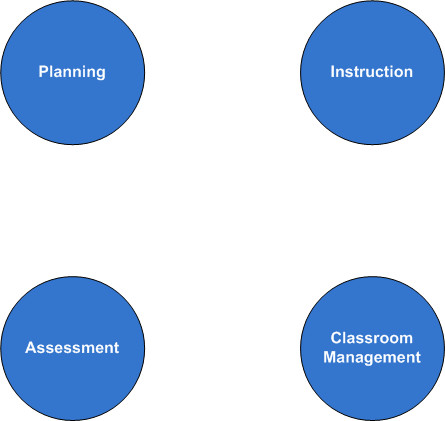
The classroom is a system. Consider just four basic components of that system: planning, instruction, assessment, and the learning environment.
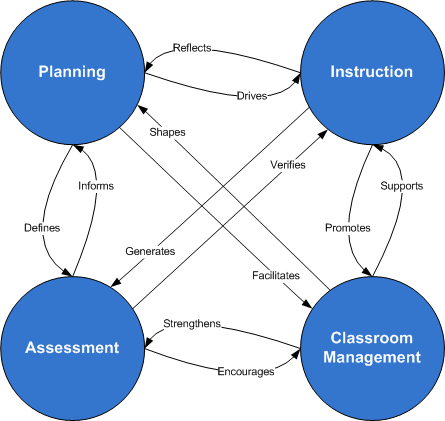
Every classroom has these components. Each aspect interacts with the others. Lesson planning drives Instruction, and in turn, Instruction reflects the Planning involved. These relationships exist between all four of these areas, and also for the many additional aspects of the classroom system not shown here.
While many people may initially focus their attention on the nodes (circles) within a systems diagram like this one, the masterful teacher can be seen in the strength of the connections (arrows and verbs) between them. A novice teacher may find that his Assessment doesn’t fully verify the breadth of Instruction, and so revisions are needed. An expert teacher is one whose Assessment truly informs Planning, and whose Planning clearly defines the Assessment.
The Learner-Active, Technology-Infused Classroom™ model addresses all aspects of the classroom system and leads to a shift of the system as a whole. LATIC teachers find that it is this aspect of the model which can seem overwhelming at times but ultimately leads to transformative, lasting change.