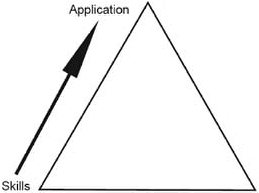
In a more conventional approach to teaching, a teacher presents a whole-class lesson using the Pythagorean Theorem. The teacher models how to use the formula and then assigns practice activities. Students are expected to correctly apply the formula to solve given problems. Essentially, skills come first and later there may be an application of those skills. Students are asked to learn content without a meaningful reason to do so.
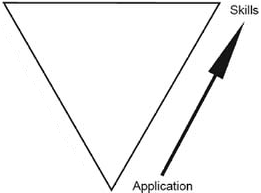
Let’s flip the triangle. Instead of presenting a lesson on the Pythagorean Theorem, begin with a problem or challenge. For example, a teacher may charge students with evaluating and improving social networks. In order to determine the strength of a social network, the students must understand and apply the Pythagorean Theorem. As a result, students have a “felt need” to learn about the Pythagorean Theorem, how it is used, and why it can be applied to this situation. The teacher has created a felt need and now must provide opportunities for students to learn and practice the skills needed to accomplish the problem-based task.
The question is not whether teachers will continue to present lessons; the question is when is the best time to teach the lessons in the learning process?