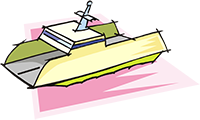
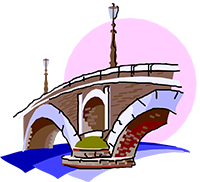
Consider the differences between travelling across a body of water on a ferry and a bridge.
Taking a ferry leaves the traveler in the hands of the boat operator and releases the traveler from all responsibility. The ferry operator decides when the boat will leave and how fast it will go. The operator moves all of the travelers across the water at the exact same time and speed.
Taking a bridge puts the traveler in control and in the seat of responsibility. Different drivers use different lanes and drive at different speeds. All who cross the start of the bridge at one time do not necessarily end up on the other side at the same time. The outcome is largely in the hands of the driver. But think about the magic of a bridge: a mass of steel suspended over a large expanse, being held in place almost miraculously, through the laws of physics. And yet, probably few travelers hold that bridge in awe as they use it to move from one land mass to another, taking control of their travel, taking the bridge for granted.
As a teacher, are you a ferry operator or a bridge builder?
Do you carry your students through the day, telling them when to do tasks and how to do them? Do you present lessons to your entire class, deciding on a pace that seems appropriate? Or do you create the structures for your students to take responsibility for their own learning allowing each of your students to achieve based on his/her specific needs?
We support teachers in establishing the structures and strategies necessary to position students to take charge of their learning. We support teachers in becoming bridge builders.
The teachers we support design problem-based tasks with analytic rubrics that allow students to self-assess and set goals. They create activity sheets that guide students through the day or week, listing the non-negotiable teacher lessons, optional mini-lessons as well as group and individual activities. Students begin the day or week by designing a personalized schedule for their work. They monitor their progress and reflect on their work habits in journals. How-to sheets are available for students to use in order to master a particular skill. They keep their work in a two-pocket folder that holds completed and in-progress activities. Teachers become facilitators, moving around the classroom meeting with individual students and groups to guide learning. They carry facilitation grids to track formative assessment data for each student. They review student folders, make comments, and suggest follow-up activities.
These are just some of the structures that masterful teachers are using to create a learning environment that puts students in charge of their learning. To see it in action in a classroom is to realize that students feel totally empowered to pursue their education and proud to take control, never realizing the incredible feat their teachers have accomplished in building it.