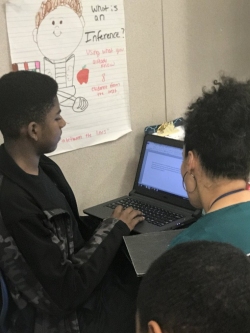
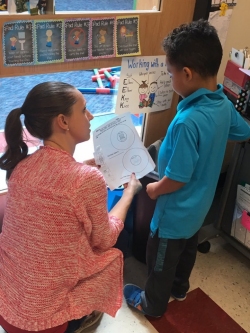
The shift from a teacher-centered to a student-centered classroom allows the teacher to leave the front of the room and directly engage with students during the learning process. The “guide on the side” is able to gain a clear sense of student learning and use that knowledge to drive instruction so that all students are challenged to reach their potential.
In the Learner-Active, Technology-Infused Classroom™, the teacher’s role shifts from presenting information to facilitating learning.
Rather than leading a whole class lesson to convey a skill to students, the teacher has crafted a variety of learning experiences in which students engage to gain an understanding of the content. As students work through these activities, the teacher is able to move through the classroom observing student interactions, assessing mastery, and guiding students toward deeper analysis of concepts.
This type of facilitation is critical to support students as they take responsibility for learning.
The facilitating instructor moves strategically through the room during student work time, sitting with individuals and groups to gain a clear sense of the student learning that is taking place.
Tips for Facilitation
- Spend only 3-5 minutes at a table so that you address all students in the room.
- Avoid engaging in a deeper discussion with a particular group of students.
- Provide direction, then check back.
- Don’t hover; sit with students at eye level.
- Identify students who have significant needs and suggest they take part in a small-group, mini-lesson or related activity before continuing.
- Prompt critical thinking through strategic questioning.